Blog / Modern Document Management System VS Traditional Filing
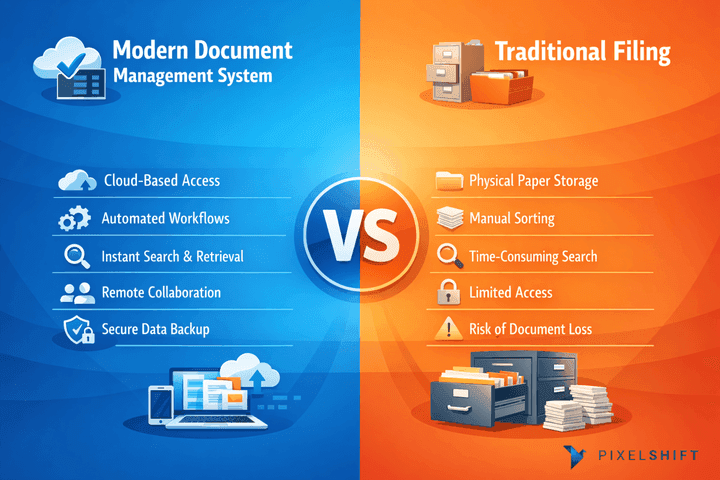
Modern Document Management System VS Traditional Filing
Explore traditional vs modern DMS: paper-based manual filing versus digital, automated, cloud-based systems for faster and secure document management.
In today’s fast-paced business world, managing documents efficiently is essential. Businesses create countless files daily, and without a proper system, important documents can get lost or delayed. The right document management approach keeps files organised, secure, and easy to access.
Companies often have to choose between an old-fashioned document management system and a new one. Traditional systems use paper files and manual filing, which can be slow and error-prone. Digital storage, cloud access, and automation are all parts of modern DMS. These features speed up workflows and make it easier for people to work together.
Understanding the differences helps businesses make smarter decisions. A modern system saves time, improves security, and supports remote work. By switching to digital document management, teams will be able to work more smoothly and get more done.
What is a Traditional Document Management System?
A traditional document management system is a way of storing and managing files using paper, physical cabinets, and manual processes instead of digital tools. Employees organise documents by hand, retrieve them manually, and keep records without using computers or automation.
While traditional systems can work for small offices, they have several challenges:
Slow retrieval: It takes longer to find a specific file as the number of documents grows.
Risk of loss or damage: Papers can get lost, torn, or destroyed.
Limited collaboration: It's slow and not very useful to share documents between teams.
Difficulty in compliance: Tracking versions and keeping audit records is complicated.
These limitations make traditional systems less effective in modern workplaces where speed, security, and collaboration are important.
What is a Modern Document Management System?
A modern document management system (DMS) is a digital, cloud-based system that helps teams store, organize, and share documents securely online. It uses automation to speed up and simplify document handling, which is different from traditional systems.
Key features include:
Automated workflows: Reduce manual work and speed up approvals.
Cloud storage: Access files anytime, anywhere.
Version control: Track changes and keep an accurate document history.
Role-based access: Decide who can view, edit, or share files.
Integration: Connect easily with email, CRM, and other business tools.
Modern DMS is great for businesses that deal with private or important information, like banks, law firms, or healthcare providers. It makes sure that everything is safe, follows the rules, and that teams can work together smoothly.
Traditional vs Digital Document Management: Key Differences
Comparing traditional and modern document management systems helps businesses see the advantages of going digital. While traditional systems rely on manual processes and physical storage, modern DMS uses automation and cloud technology for faster, safer, and more efficient workflows.
Understanding the differences between manual vs automated document management helps businesses make informed decisions:
Storage Challenges in Traditional vs Modern DMS
In traditional systems, documents are stored in physical cabinets, filing rooms, or even scattered across desks. This not only takes up valuable office space but also makes organisation and retrieval difficult. Over time, files can be misplaced, mislabelled, or damaged by environmental factors like moisture or fire.
Modern DMS eliminates these problems by storing files digitally in the cloud. Cloud storage allows documents to be organised into folders, tagged, and easily searchable, all without taking up physical space. Additionally, files can be accessed from anywhere, ensuring teams can work remotely without relying on paper-based storage.
Efficient Document Retrieval
With a traditional DMS, finding a specific document can be time-consuming and frustrating, especially if records are large or poorly organised. Employees often spend hours searching through cabinets, leading to delays in decision-making and lost productivity.
Modern DMS uses powerful search tools and metadata tagging, allowing users to locate documents instantly. You can search by keywords, document type, author, or date, ensuring quick and precise retrieval. This speed improves operational efficiency and reduces the frustration associated with manual searching.
Collaboration Across Teams
Traditional DMS limits collaboration because files are usually accessible only in person, making it difficult for multiple team members to work together. Sharing documents often involves physically sending copies or scanning and emailing files, which can create version confusion.
Modern DMS allows real-time collaboration, meaning multiple users can access, edit, and comment on documents simultaneously. Remote teams can work together seamlessly, and changes are updated instantly, improving coordination, reducing errors, and speeding up project completion.
Enhanced Document Security
Physical locks and restricted cabinet access in traditional DMS offer only basic protection. Documents can still be stolen, misplaced, or accessed by unauthorised personnel, especially if employees leave or offices are shared.
Modern DMS employs encryption, role-based access controls, and detailed activity logs to protect sensitive data. Only authorised users can view or edit documents, and all actions are tracked for accountability. Security features like multi-factor authentication and secure cloud backups also protect against data loss, cyberattacks, or accidental deletions.
Automatic Version Control
Tracking document versions manually in traditional DMS is prone to errors. Earlier versions can be lost, overwritten, or difficult to trace, leading to confusion and mistakes.
Modern DMS automatically saves every version of a document. Users can view revision history, revert to previous versions, or compare changes, ensuring complete transparency and accuracy. This feature is critical for industries like legal, finance, and healthcare, where precise document histories are essential for compliance and accountability.
Streamlined Workflow Efficiency
Traditional document management is often slow and labour-intensive. Employees manually route documents for approval, track revisions on paper, and handle repetitive tasks like filing and archiving. This results in delays, errors, and wasted resources.
Modern DMS automates these workflows, from approvals to notifications, reducing manual intervention. Automated workflows ensure tasks move seamlessly between team members, deadlines are met, and productivity is maximised. Teams can focus on core activities instead of administrative bottlenecks.
Scalability for Growing Businesses
As businesses expand, traditional DMS struggles to manage the increasing volume of documents. More storage space is needed, filing staff may be required, and manual processes become inefficient.
Modern DMS is highly scalable, capable of handling large volumes of digital documents without extra physical infrastructure. Cloud-based systems can grow with the organisation, allowing businesses to add users, storage, or workflows easily without disrupting operations, making them ideal for companies of all sizes.
Compliance and Audit Made Easy
Manual compliance tracking in traditional DMS is error-prone and difficult to maintain. Organisations must spend extra time auditing files, tracking revisions, and ensuring regulatory adherence.
Modern DMS simplifies compliance with built-in audit trails, access logs, and automatic versioning. Organisations can quickly generate reports, track document history, and demonstrate regulatory compliance, reducing legal risks and improving accountability across the business.
Cost Savings with Modern DMS
Traditional systems incur ongoing costs for paper, printing, filing cabinets, storage space, and administrative labour. These costs grow as the business scales. Modern DMS reduces expenses significantly by eliminating paper, reducing storage needs, and automating routine tasks.
Cloud-based storage and digital workflows lower operational costs while also improving efficiency. Over time, investing in a modern DMS provides substantial savings, making it a cost-effective solution for businesses of all sizes.
| Feature | Traditional DMS | Modern DMS |
|---|---|---|
| Storage | Documents are stored in physical cabinets or filing rooms, which take up space and can be hard to organise. | Files are stored digitally in the cloud, reducing physical storage needs and making organisation easy. |
| Retrieval | Searching for documents is manual and time-consuming, often requiring sifting through stacks of papers. | Documents can be found instantly using search functions, saving time and improving efficiency. |
| Collaboration | Sharing files across teams is limited and mostly in person, making teamwork slow. | Teams can collaborate in real-time, with remote access and simultaneous editing. |
| Security | Protected by physical locks, and access is limited to those near the storage location; sensitive data is at risk. | Uses encryption, secure access controls, and activity logs, ensuring documents are protected even remotely. |
| Version Control | Tracking changes is manual, making it easy to lose earlier versions or create confusion. | Automatic versioning ensures every change is saved, and previous versions can be accessed anytime. |
| Efficiency | Processes are slow and labour-intensive, leading to wasted time and potential errors. | Fast and automated workflows streamline approvals, sharing, and storage. |
| Scalability | Difficult to scale as document volume increases; requires more physical space and staff. | Easily scalable for large volumes of documents, supporting growing businesses without extra physical resources. |
| Compliance & Audit | Maintaining compliance is manual and error-prone, with limited tracking of document history. | Built-in audit trails and compliance features help meet regulatory requirements efficiently. |
| Cost | Costs include printing, paper, and physical storage maintenance. | Reduces costs by minimising paper, storage, and administrative overhead. |
As businesses grow, traditional systems struggle to scale, while modern DMS solutions can handle large volumes of documents efficiently.
Take control of your files with PixelShift’s modern document system. Schedule a demo now!
Why Businesses Should Upgrade to a Modern DMS
Traditional document management systems often cause slow workflows, misplaced files, limited collaboration, and compliance headaches. Teams spend too much time searching for paper documents, sharing files is inefficient, and tracking changes can be difficult.
Upgrading to a modern document management system solves these issues by streamlining processes, improving security, and enabling real-time collaboration, helping businesses work faster and more efficiently.
Switching from a traditional to a modern document management system offers several benefits:
Improved Productivity: Teams spend less time searching for files and more time focusing on core tasks.
Enhanced Security: Digital systems include encryption, access control, and logs of audits.
Better teamwork: Several people can open and change files at the same time.
Better Collaboration: Multiple users can access and edit files simultaneously.
Compliance Made Easy: Track all changes and maintain records for regulatory needs.
Cost Savings: Reduce paper, printing, and physical storage expenses.
For organisations seeking a modern document management system, tools like PixelShift DMS offer a secure, organised, and scalable solution.
Traditional vs Modern DMS: Final Thoughts
Traditional document management systems have served businesses for years, relying on paper files, manual filing, and physical storage. While they worked in the past, they often caused delays, errors, and collaboration challenges, especially as document volumes grew and compliance requirements increased.
Switching to a modern, digital, and automated DMS solves these problems by enabling real-time collaboration, secure cloud storage, version control, and streamlined workflows. For businesses still using manual processes, adopting a modern system like PixelShift DMS is a smart move that improves productivity, ensures security, and prepares organisations for future growth.
Take Your Document Management to the Next Level Don’t let manual processes slow your business down. Try PixelShift DMS now and simplify how your team stores, shares, and secures documents.
FAQs
What is the difference between a traditional DMS and a modern DMS? A traditional DMS relies on paper files, physical cabinets, and manual processes, while a modern DMS is digital, cloud-based, and automated. Modern systems allow faster retrieval, secure storage, real-time collaboration, and easier compliance.
Why should businesses switch to a modern DMS? Switching to a modern DMS improves productivity, reduces errors, enhances security, and enables seamless collaboration. It also helps businesses scale efficiently and meet compliance requirements easily.
Is a modern DMS secure for sensitive information? Yes. Modern DMS systems like PixelShift use encryption, role-based access controls, and activity logs to ensure documents are safe, even when accessed remotely.
Can multiple users work on the same document at the same time? Absolutely. Modern DMS allows real-time collaboration, so multiple team members can edit, comment, and access documents simultaneously without conflicts.
How does a modern DMS save costs compared to traditional systems? By reducing paper, printing, physical storage, and administrative labour, a modern DMS lowers operational costs while increasing efficiency and productivity.
Can a modern DMS help with compliance and audits? Yes. Modern DMS includes audit trails, automatic version control, and tracking features that make it easier to meet regulatory requirements and maintain proper documentation.